Baking Soda vs. Baking Powder
Baking soda and baking powder can cause quite a lot of confusion in the kitchen. In addition to their similar name, the substances are both white powders used as a chemical leavener to produce carbon dioxide in cakes, muffins, and other baked goods. The two agents are commonly used in tandem, but minor cooking catastrophes can result if they are mistaken for each other.
Because of their chemical composition, baking soda and baking powder react with different reagents in different conditions. It is essential for recipes to account for this with proper supporting ingredients and procedures.
Baking Soda:
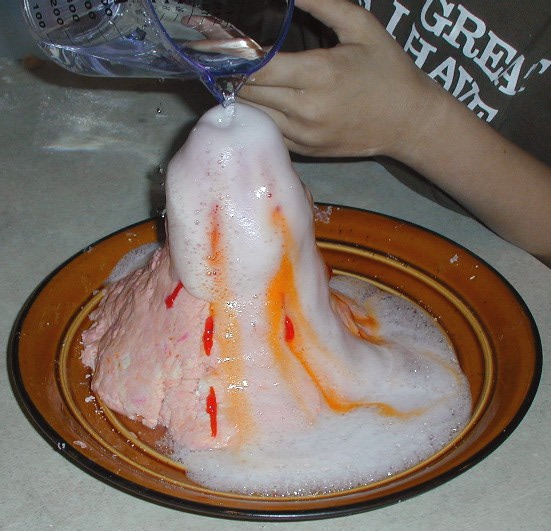
Image by Anne Helmenstine
Terminology:
ion- an atom or molecule with a net charge
cation-a positively charged ion
anion- a negatively charged ion
The famous science-fair-volcano reactant, fridge de-odorizer, and natural toothpaste ingredient is also a wonderfully useful ingredient in edible products. Baking soda is simply sodium bicarbonate (NaHCO3). This ionic compound dissociates in water, providing a sodium cation (Na+) and a bicarbonate anion (HCO3-). The bicarbonate ion is amphoteric, meaning it can act as either an acid (by losing its hydrogen ion to form CO32-) or as a base (by gaining a hydrogen ion to form H2CO3). In baking situations, it is advantageous to combine baking soda with an acid solution such as vinegar (acetic acid), lemon juice (citric acid), cream of tartar (tartaric acid), or buttermilk (lactic acid), because this forces the bicarbonate ion to act as a base and form carbonic acid (H2CO3). Carbonic acid quickly decomposes into water (H2O) and carbon dioxide gas (CO2).
Example Step-Wise Chemical Reaction:
Sodium Bicarbonate (Baking Soda) and Acetic Acid (Vinegar)

Step 1: NaHCO3(s)+ HC2H3O2(aq) → NaC2H3O2(aq)+ H2CO3

This is a double replacement reaction; the cations of the reactants switch anions to form the products. Carbonic acid is formed.

Step 2: H2CO3 → H2O(l)+ CO2(g)

Carbonic acid from Step 1 immediately decomposes into water and    carbon dioxide gas.

Overall Rxn:NaHCO3(s)+HC2H3O2(aq)→ NaC2H3O2(aq)+H2O(l)+CO2(g)
CO2 gas bubbles are produced immediately upon contact with the acid, and thus, when using baking soda, it is important to get the batter or dough directly into the oven after mixing the wet and dry ingredients. This minimizes the amount of leavening gas that dissipates out of the un-baked product as the bowl sits on the counter. It is also important to avoid over-mixing doughs and batters containing baking soda, because agitation helps gas to escape.
Once the dough or batter is exposed to high temperature conditions in the oven, the CO2 gas molecules become excited, expanding and shaping the surrounding protein structures to form airy products.
Baking Powder:
Most baking powders contain the label “Double Acting”. A more explicative name from a chemistry standpoint would be “Double Reacting”, because double acting Baking Powder contains two different acids that react with sodium bicarbonate. The first acid is tartaric acid or monocalcium phosphate, which, in the presence of water, dissolves and reacts immediately with the sodium bicarbonate to form carbon dioxide bubbles. The second acid is traditionally sodium aluminum sulfate**, which requires temperatures of around 140 degrees to react with the remaining sodium bicarbonate. This heat-activated reaction is why cakes containing baking powder will rise significantly a few minutes after entering the oven, when the internal temperature of the batter has passed the energy threshold that allows the second acid-base reaction to occur.
There are several advantages of baking powder. Conveniently, the ratios of each acid and the sodium bicarbonate are calculated by manufacturing companies to achieve the maximum amount of carbon dioxide gas; there is no need to worry about adding too little acid and inhibiting rising. This calculated ratio also means that all of the sodium bicarbonate reacts with acid and there is no bitter, alkaline aftertaste from its remains. Another benefit of baking powder is that the second rising allows chefs to take their time shaping products before they enter the oven (biscuits and scones are a great example of this). Lastly, the baking powder’s inert stabilizer (such as cornstarch) absorbs moisture during storage, preventing premature reactions and keeping the agent “fresh”.

**In large doses, sodium aluminum sulfate has been shown to potentially cause brain damage and kidney failure. Because of this, brands such as Rumford do not contain any sodium aluminum sulfate and exclusively use monocalcium phosphate as an acid. In the first mixing, the monocalcium phosphate forms a dormant intermediate (dicalcium phosphate), which later reacts to form gas at temperatures over 140 degrees Fahrenheit.
Image by amazon.com
Sources
“Baking Powder vs. Baking Soda, When and Where to Use Which.” Pastries Like a Pro, 27 June 2013, pastrieslikeapro.com/2013/06/baking-powder-vs-baking-soda-where-and-when-to-use-which/.
“Baking Powder.” Wikipedia, Wikimedia Foundation, 19 July 2018, en.wikipedia.org/wiki/Baking_powder.
“Double-Acting Baking Powder | Baking Ingredients.” Bakerpedia, bakerpedia.com/ingredients/double-acting-baking-powder/.
“Here’s the Difference Between Baking Soda and Baking Powder.” Real Simple, Real Simple, http://www.realsimple.com/food-recipes/cooking-tips-techniques/baking/baking-soda-vs-baking-powder.
Shipman, Matt. “The Difference between Baking Soda and Baking Powder.” Phys.org – News and Articles on Science and Technology, Phys.org, 22 May 2014, phys.org/news/2014-05-difference-soda-powder.html.
Stradley, Linda. “Baking Powder, Whats Cooking America.” What’s Cooking America, 7 Oct. 2017, whatscookingamerica.net/baking-powder.htm.
 Burns Bites
Interesting stuff. Definitely checking labels for sodium alum now.
LikeLike